Going AI-native in clinical research: 5 pitfalls nobody warns you about
Everyone in clinical research has AI now. Almost no one is talking about what it costs when it’s wrong. Here are five failure modes we’ve learned to catch — and why the expertise is in the checking, not the model.
Walk any clinical research conference floor this year and you will hear one word more than any other: AI. Every feasibility tool is AI-powered, every site-selection platform is AI-driven, every vendor is going AI-native. The potential is real — we have spent the last year rebuilding how we work around it, and the speed is genuine. But there is a quieter truth that almost no one puts on a slide: AI is confidently, fluently wrong on a regular basis, and in clinical research a wrong answer does not stay small. It becomes a site that never enrolls, an amendment you could not afford, a bid defense that falls apart under one sponsor question.
As one of our team put it: you can’t just say you have AI. That doesn’t solve it all. You have to put real effort into it. Here are the five pitfalls that effort is spent on — the ones we have lived through, so you can see them coming.
Pitfall 01“Verified” doesn’t mean verified
An AI will hand you a number wrapped in confidence it has not earned. It will label a result “verified,” “high-confidence,” or “validated” because that is the shape of a good answer — not because anything was checked. The label is not the proof. If you cannot trace a figure back to the exact data and the exact query that produced it, you do not have a figure. You have a guess with good posture. The first discipline of AI-native work is refusing to accept the machine’s own grade on its own homework.
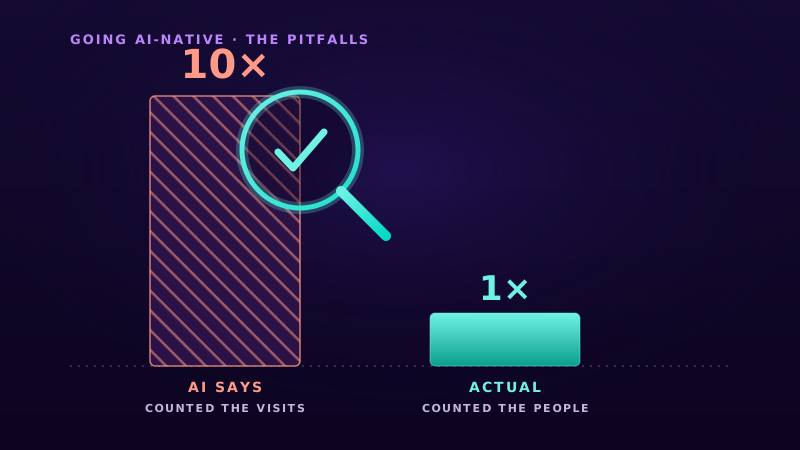
Pitfall 02It counts visits, not people
This is the classic, and it is expensive. You ask an AI system for the number of patients who match a protocol, and it returns the number of encounters — the same patient counted every time they showed up. Ten visits, one patient, but the system reports ten. Your eligible pool looks several times bigger than it is, feasibility greenlights the plan, and nobody notices until enrollment stalls and the sites you picked cannot find the people who were never really there.
Adding AI is easy. Knowing when not to trust it is the job.
Pitfall 03One agent’s guess becomes the next agent’s fact
The frontier right now is chaining agents together — one drafts, one researches, one summarizes, one decides — and letting the fleet run. It is genuinely powerful. It is also how a small error stops being small. An early agent’s shaky assumption gets passed downstream as settled input, and three steps later it is wearing a tie and calling itself a conclusion. Without a human checkpoint between the links, you are not automating analysis. You are automating confidence, and compounding whatever was wrong at the start.
Pitfall 04The bill is real
“Let the AI handle it” sounds free. It is not. Running fleets of agents, re-running them when they drift, and processing large datasets through them burns compute — and the meter runs whether the output was any good or not. Teams going AI-native without watching this quietly turn an efficiency story into a cost overrun nobody budgeted for. Done well, AI-native is more deliberate than the old way, not less: you spend on the runs that matter and you know why.
Pitfall 05“We have AI” is not a strategy
Bolting a model onto an unchanged process does not transform it; it just adds a confident narrator to the same work. The real work — the part that is hard, and the part that is worth paying for — is in the guardrails: the checks, the traceability, the de-duplication rules, and the people who know what a wrong answer looks like before a client ever sees it. “AI-powered” on a homepage is a sticker. Being genuinely good at AI is a practice.
So what does AI-native actually take?
Not less human judgment — more of it, aimed better. The teams that win the next few years will not be the ones who adopted AI fastest. They will be the ones who knew where it breaks and built for that from day one: speed from the machine, verification from the experts, and real, patient-level data underneath it all — a hard rule that no number reaches a sponsor until someone who understands it has stood behind it. That is the part we care about most — and the part the slides tend to skip.
AI in clinical research, answered
What does AI-native mean in clinical research?
Going AI-native means rebuilding how work gets done around AI rather than bolting a chatbot onto an old process. In clinical research that can speed up feasibility, site selection and literature work — but only when expert review is built into every step, because the model is the easy part and the guardrails are the hard part.
What are the risks of using AI for clinical trial feasibility?
The main risks are false confidence (an AI labels a number “verified” it cannot justify), inflated patient counts (counting visits or claims instead of distinct patients), compounding error across chains of agents, and unbudgeted compute cost. Each is catchable, but only by someone who knows what a wrong answer looks like.
Can AI do clinical trial site selection on its own?
AI can accelerate clinical trial site selection, but on its own it will confidently surface sites that look right and miss sites that are right. The reliable pattern pairs AI speed with real, patient-level data and expert verification — data, not vibes.
Why do you still need an expert if you have AI?
Because adding AI is easy and knowing when not to trust it is the job. AI raises the stakes on judgment rather than removing the need for it: it produces answers fast, and an expert is what stands between a fast answer and a wrong one reaching a sponsor.