Rare disease: from protocol to site list, on one evidence base
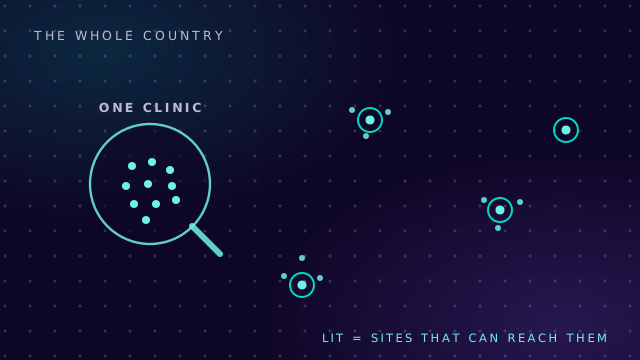
A sponsor designing a trial for a rare disease had world-class experts at the design table, and still could not answer the question the whole program hinged on: how many patients would actually qualify under the draft criteria? An expert sees their own clinic. No one sees the whole country. Our data does.
Part IThe counting question the experts couldn’t answer
The problem
The draft protocol demanded a heavy, documented treatment history. Every criterion felt clinically reasonable, but no one could say what each one cost in eligible patients, or which ones were quietly strangling the enrollment pool. Expert intuition cannot answer a counting question.
What we did
We translated the draft protocol into patient-level logic over the real patient record, then isolated each criterion and modeled protocol variants one lever at a time — measuring exactly how many patients each version gained or lost, while checking that the enrolled population stayed aligned with the trial’s target phenotype and endpoints. The sponsor could see, criterion by criterion, where the protocol could safely open up and where it should not move.
The outcome
The final protocol qualified nearly 3× the patients of the initial draft — same scientific intent, dramatically better enrollment odds — with every criterion’s cost known before a single site was activated.
They guess. We count.
Part IIThe answer becomes a site list
The problem
A bigger eligible pool only matters if your sites can reach it — and in an ultra-rare disease, most sites, however prestigious, simply do not treat these patients. The conventional shortlist of big academic names answers the wrong question. In fact, we found that many of the marquee centers had few or no patients who met the protocol’s strict criteria.
What we did
We ran the final protocol through our Quantum Intelligence Engine. Because the eligibility model and the site data live in the same database, we could attach to every candidate investigator both a measured enrollment track record and the exact number of protocol-qualified patients seen by that investigator and their institution. Patient access became a hard gate, enriching the shortlist of consistently high-performing principal investigators the engine identified.
The outcome
A ranked list of sites, each pairing a consistently high-enrolling investigator with a counted population of protocol-qualified patients — including strong sites the conventional lists would never surface, and excluding marquee centers with no reachable patients. Site selection and enrollment de-risked with the same evidence, before activation dollars were spent.
Feasibility, site selection & bid defense
What is clinical trial feasibility?
Clinical trial feasibility asks whether a study can realistically enroll — and where. Done well, it counts the real, qualifying patients a protocol can reach and the sites that can actually enroll them, rather than inferring from a limited sample.
How do you choose clinical trial sites?
The strongest clinical trial site selection pairs a named, vetted, high-performing investigator with a real count of protocol-qualifying patients under their care and at their institution — ranked on evidence, not reputation. Data, not vibes.
What is a bid defense?
A bid defense is the meeting where a CRO defends its proposed sites and enrollment plan to the sponsor. Walking in with real, patient-level qualifying patient counts — down to a number — is what wins it. More on winning a bid defense →